🎓
Academic Learning Series
A platform for learning research processes through academic sharing and mentoring.
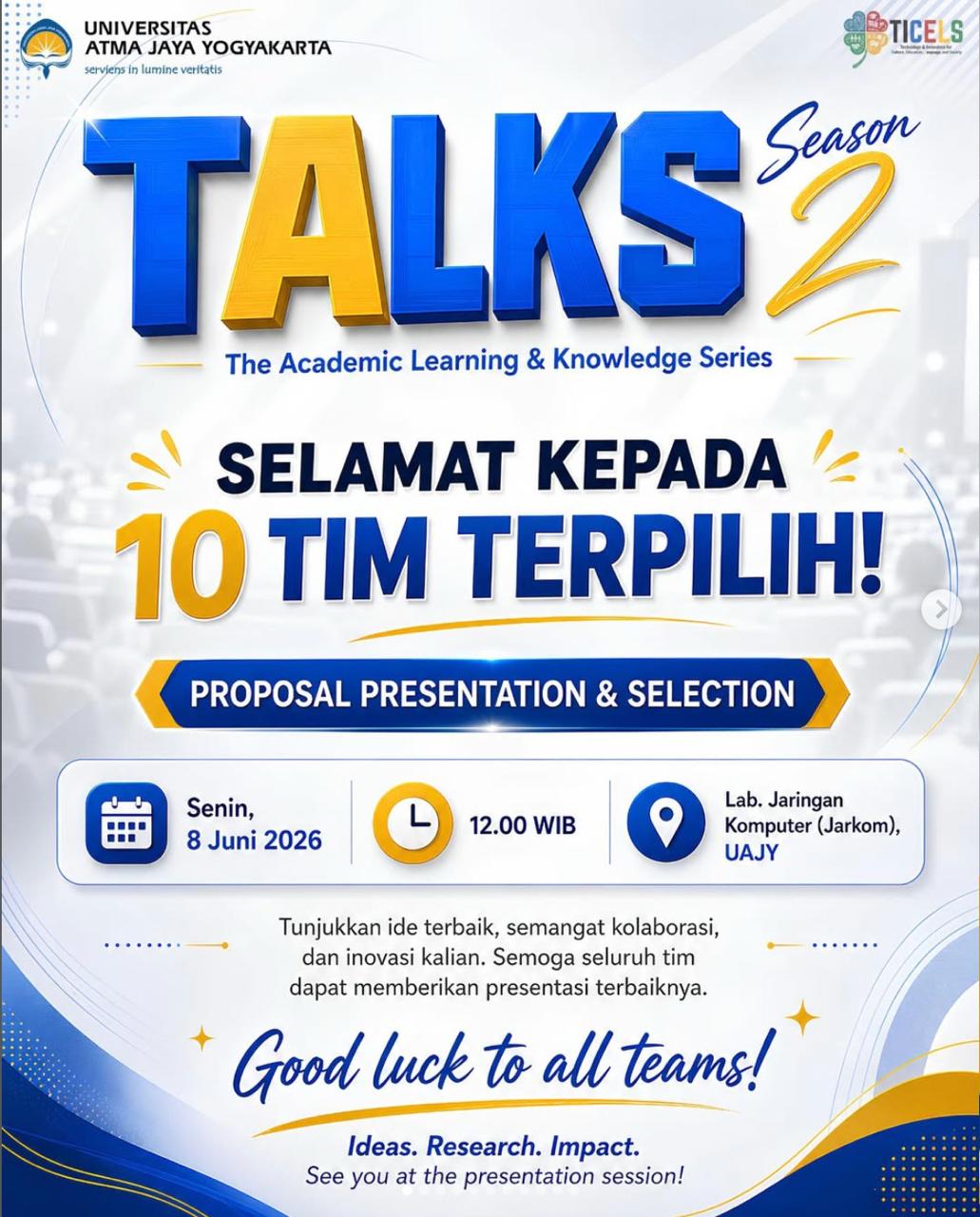
The journey continues. Ten selected teams of TALKS Season 2 are ready to present their best research ideas in the next stage of the Collaborative Research Bootcamp: From Ideas to Publications. In this session, each team will pitch their proposal, receive feedback, and compete to become the best teams to continue developing their ideas into meaningful academic output
Start with the opening ceremony, meet the mentors, and explore pathways toward publications or competition projects.
The Academic Learning & Knowledge Series (TALKS) is an academic learning initiative organized by the Master of Informatics Program Universitas Atma Jaya Yogyakarta in collaboration with the TICELS Research Group (Technology & Innovation for Culture, Education, Language & Society). This initiative is designed to encourage academic spirit and foster a healthy research culture among students, lecturers, and research groups. TALKS provides a space for discussion, knowledge sharing, and reflection on research as a long-term learning journey — not merely as a process that ends in publication. Through the theme “Start Your Research Story,” TALKS invites students and lecturers to explore research experiences, develop ideas, strengthen academic writing, and build meaningful research outputs. The program features experienced speakers and is conducted regularly as part of a continuous effort to support collaborative academic development within the university environment.
A platform for learning research processes through academic sharing and mentoring.
A space where students and lecturers can explore research ideas together.
An initiative that encourages students to develop research outputs for publication and academic dissemination.
A program that supports research-based projects and innovation competitions such as GEMASTIK.
TALKS Season 2 is designed as a collaborative research bootcamp for UAJY undergraduate students, especially students from the Department of Informatics, to work together with lecturer mentors and develop research ideas into academic outputs.
Students will be introduced to lecturer mentors and their research areas.
Students can explore research ideas from their own interests or from lecturer-led research topics.
Student teams will prepare a light research proposal under lecturer guidance.
Teams will present their proposals and receive feedback from reviewers.
Selected teams will continue to an intensive mentoring phase.
The final outputs will be directed toward publication or competition projects.
A glimpse of the TALKS Season 2 Opening Ceremony, where students were introduced to the research bootcamp journey, lecturer mentors, research tracks, and proposal submission process.
This highlight collage displays selected documentation from the opening ceremony. Photos are shown randomly from the OC folder so the documentation area feels fresh each time the page is opened.
TALKS Season 2 provides three research tracks that help student teams choose a direction based on their interests, project readiness, and expected output.
Focuses on user behavior, technology acceptance, trust, user experience, and responses toward digital systems.
Target output: AnalysisFocuses on designing and developing digital prototypes, applications, systems, or interactive products.
Target output: PrototypeFocuses on building simple AI models for classification, prediction, recommendation, or chatbot-based solutions.
Target output: AI PrototypeFor teams that want to analyze why users accept, trust, use, or respond to a technology.
For teams that want to design, build, and test a web, mobile, learning, cultural, game, VR, or UI/UX prototype.
For teams that want to build a simple AI prototype based on data, machine learning, classification, prediction, recommendation, or chatbot logic.
Students can explore research topics and discuss proposal ideas with our lecturer mentors, which part of TICELS Research Group.
Judges will review proposal clarity, research relevance, methodological feasibility, potential outputs, and alignment with publication or competition pathways.
This section highlights the ten selected teams that will continue to the collaborative research bootcamp phase.
The bootcamp is conducted in several stages, beginning with the opening ceremony and continuing through proposal development, presentation, selection, and mentoring.
Introduction to TALKS Season 2, bootcamp goals, lecturer mentors, research areas, and program mechanism at Kampus 3, Gedung Bonaventura Universitas Atma Jaya Yogyakarta, Room 3303, 3rd Floor.
Student teams submit their research proposals after discussion and guidance with lecturer mentors.
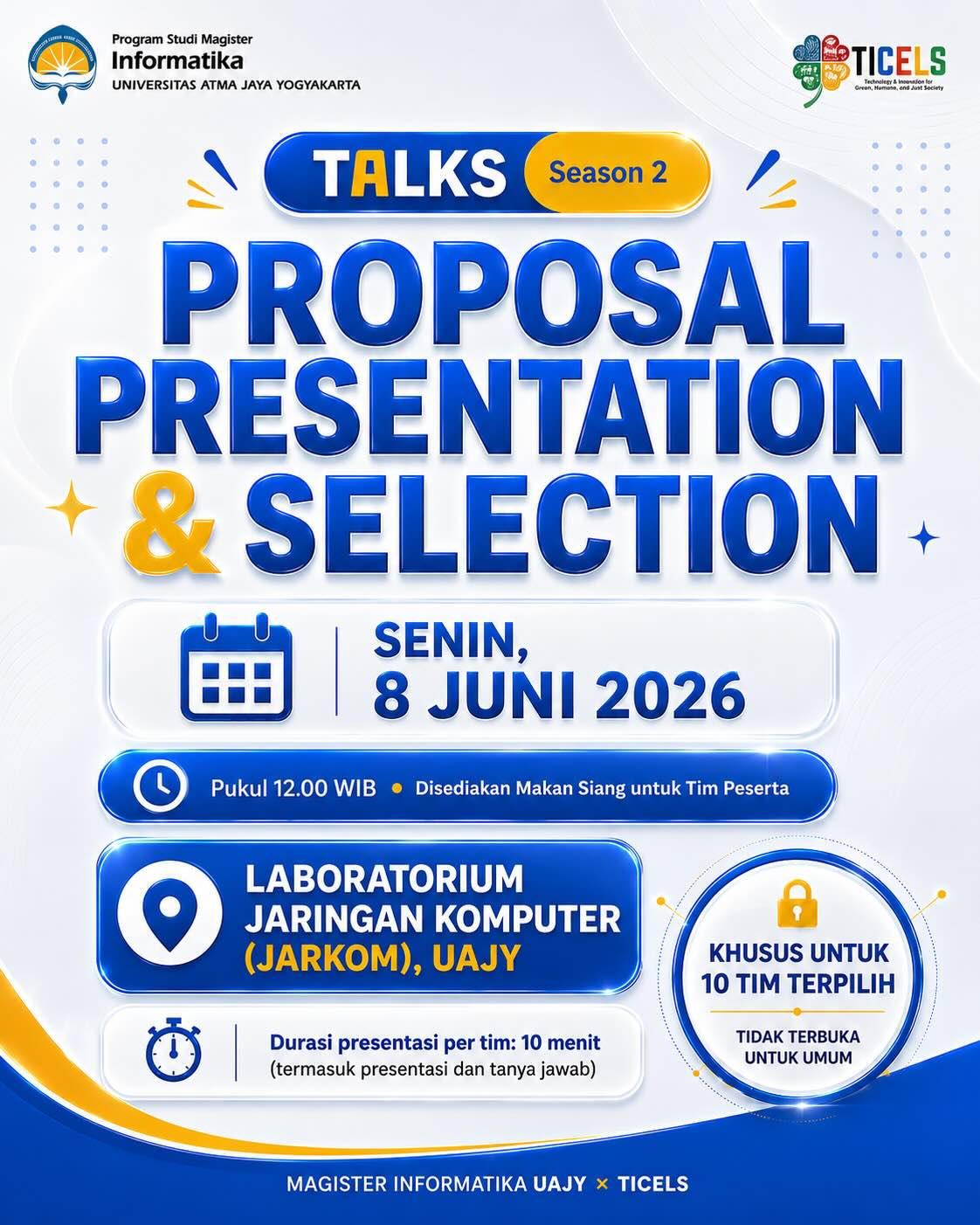
Teams present their proposals. The best 10 teams will be selected to continue to the bootcamp phase.
Selected teams join hybrid weekly mentoring sessions with lecturer mentors to refine their research direction, proposal structure, and project plan.
Teams review their progress, strengthen the research design, and prepare the next development stage with mentor feedback.
Selected teams continue weekly mentoring through offline meetings to deepen the project, improve the manuscript or prototype, and prepare concrete outputs.
Teams finalize their outputs, including publication drafts, project documents, or GEMASTIK-oriented deliverables, based on mentor guidance.
Only selected teams will continue to the intensive bootcamp phase and receive further mentoring to develop their research outputs.
TALKS Season 2 is designed to help students develop research ideas into academic and innovation outputs.
Selected projects may be developed into manuscripts targeted for international publication opportunities.
Research ideas may be developed into articles for national journals or conference proceedings.
Innovation-oriented projects may be prepared for GEMASTIK or similar student competitions.
The final output will depend on the research topic, project readiness, mentor guidance, and student team commitment.
TALKS Season 2 positions students as the center of the research process. Students are encouraged to actively contribute to idea development, proposal writing, data collection, analysis, and final output preparation.
The program is designed not only to help students learn about research, but also to provide meaningful academic experience, research portfolio, and publication or competition opportunities.
They may have the opportunity to become first authors in the resulting publication or project, depending on their contribution.
Access TALKS materials, proposal templates, guidelines, and supporting documents. For the MVP version, files can be stored on Google Drive and linked from these buttons.
Selected student teams are required to upload their presentation file for the Proposal Presentation & Selection session. The presentation should be prepared based on the proposal that has been submitted previously.
Each team is required to upload their presentation file in PPT, PPTX, or PDF format.
Open Submission Presentation File FormAfter proposal submission, selected student teams will present their research ideas on 8 June 2026. The session is designed to provide feedback, assess proposal readiness, and select teams that will continue to the bootcamp phase.
Selected teams will join online weekly mentoring sessions in July-August 2026 and offline weekly mentoring sessions in September 2026 to improve their research design, strengthen the proposal, develop the project, and prepare the expected outputs.
Refining research questions and clarifying the research problem.
Strengthening literature review, theoretical foundation, and research positioning.
Improving research design, methods, instruments, or prototypes.
Preparing instruments, collecting data, developing prototypes, or refining project direction.
Developing manuscripts or project documents for academic dissemination.
Preparing outputs for publication, GEMASTIK, or similar student competitions.
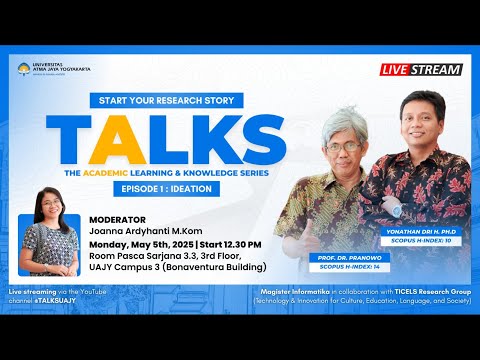
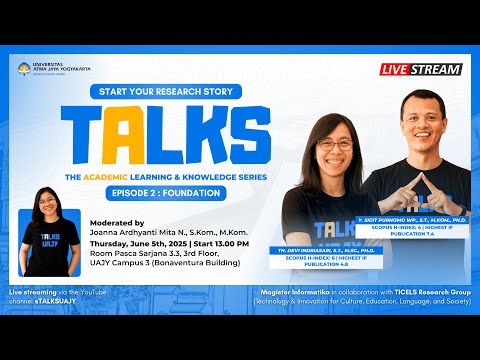
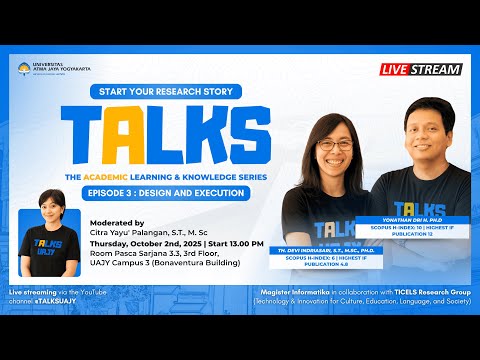
TALKS Season 1 was introduced as “Start Your Research Story”, a learning series designed to guide students through the research journey, from ideation to dissemination. This section provides a quick recap and embedded video thumbnails from the TALKS UAJY YouTube channel.
Introducing how research ideas are developed from academic interests, problems, and real-world phenomena.
Strengthening the theoretical foundation, literature review, and research positioning.
Exploring research design, methods, data collection, and execution strategies.
Reflecting on the research process and discussing how research outputs can be disseminated.
Rekaman dari Acara TALKS Season 1, dari episode 1 hingga 4.
Riset itu nggak serumit yang kamu kira. Bukan soal gelar, tapi soal kepekaan. Ide riset itu nggak turun dari langit, seringnya justru datang dari hal-hal yang sering kamu keluhkan sendiri.
Punya ide riset? Keren! Tapi jangan buru-buru eksekusinya. Bayangkan: ide riset itu seperti gambar rancangan arsitektur—visi besarnya udah ada di kepala. Tanpa fondasi yang kuat, bangunan itu bisa ambruk sebelum jadi.
Langkah penting setelah kamu punya ide riset dan fondasi yang kuat adalah mendesain dan mengeksekusi penelitian dengan tepat.
Punya penelitian yang bagus itu belum cukup. Yang bikin risetmu bermakna adalah ketika kamu merefleksikandampaknya dan menyebarkannya agar bisa berkontribusi lebih luas.
Explore documentation from previous our activities.
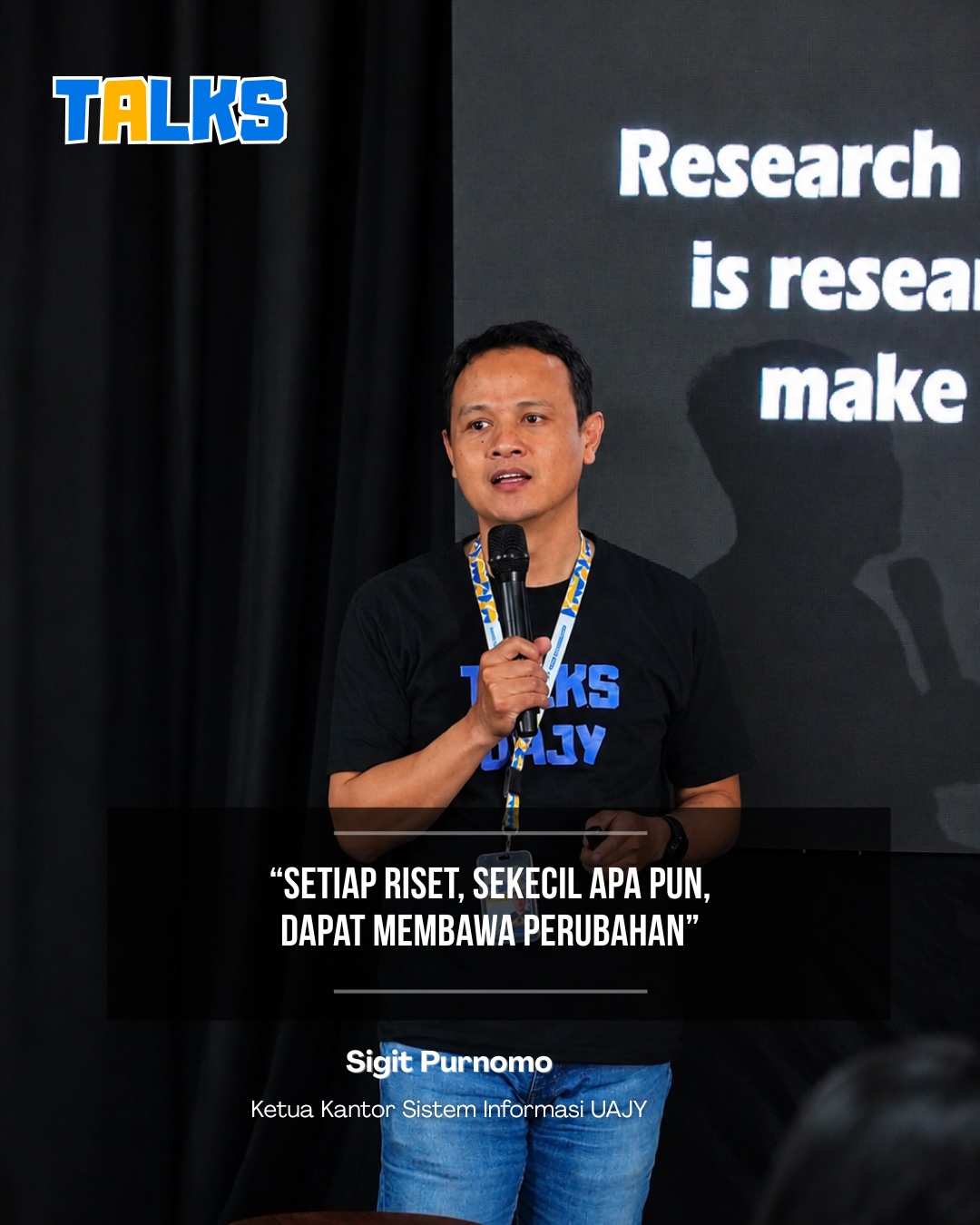
Documentation highlight from TALKS Season 1 sharing session.
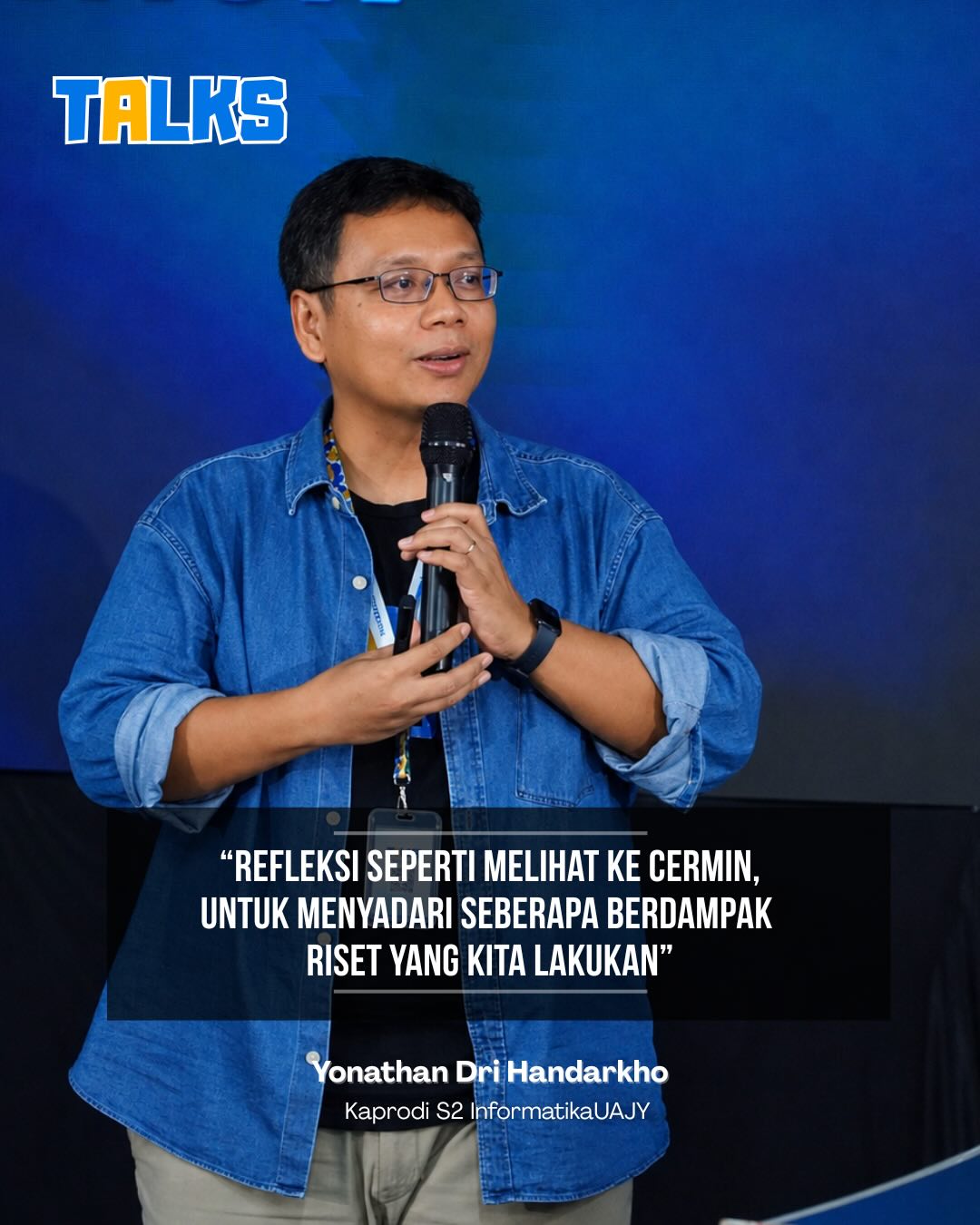
Documentation highlight from TALKS Season 1 sharing session.
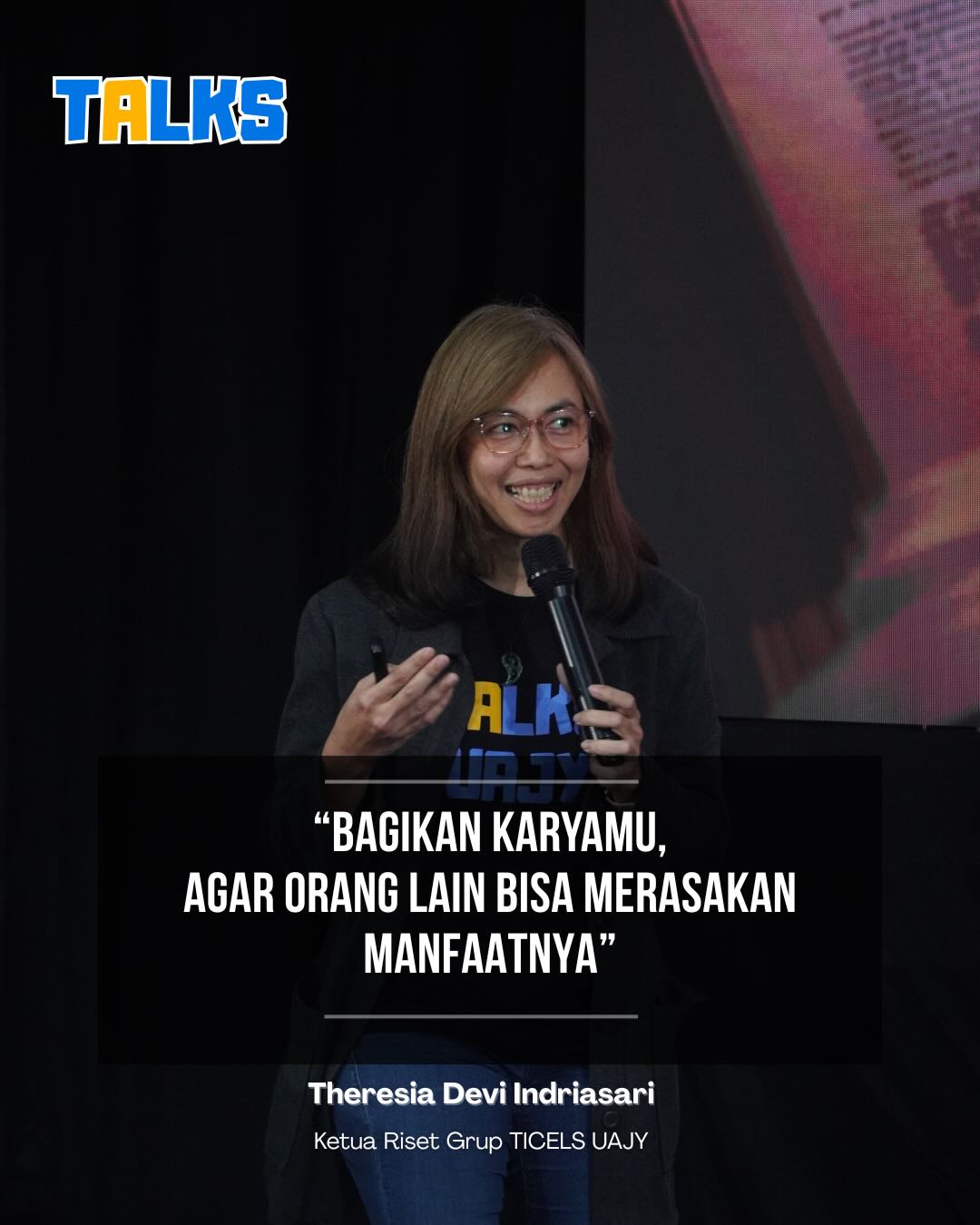
Documentation highlight from TALKS Season 1 sharing session.
Documentation highlight from TALKS Season 1 sharing session.
Speaker highlight on the importance of research impact.
Documentation highlight from a TALKS Season 1 session.
Research learning moment from TALKS Season 1.
Documentation highlight on precise design and execution.
Speaker highlight on the role of methodology in research success.
Find detailed information about TALKS Season 2, including registration, proposal submission, team requirements, selection process, mentoring activities, and expected outputs.
TALKS Season 2 is a collaborative research bootcamp organized by the Master of Informatics Program Universitas Atma Jaya Yogyakarta in collaboration with the TICELS Research Group. This season carries the theme "Collaborative Research Bootcamp: From Ideas to Publications."
The program is designed to help undergraduate students transform research ideas into concrete academic or innovation outputs through proposal development, presentation, selection, and mentor-guided bootcamp activities.
TALKS Season 2 is open only to UAJY undergraduate students, especially students from the Department of Informatics, who are interested in research, academic writing, innovation projects, publication opportunities, or student competitions such as GEMASTIK.
Students do not need to already have a complete research proposal before joining. The program is suitable for students who have early ideas, research interests, project concepts, or simply want to learn how to develop a stronger research direction.
No. Previous research experience is not mandatory. TALKS Season 2 is designed as a learning and mentoring space where students can gradually understand how to develop a problem statement, build a theoretical foundation, design a method, and prepare possible outputs.
Students with prior research, competition, or project experience are also welcome because the bootcamp can help refine their ideas into a more structured academic or innovation plan.
No. Opening ceremony registration is used for attendance confirmation and event reminders. Proposal submission is a separate process that must be completed through the official submission form.
Students should register for the opening ceremony first, attend the session to understand the program mechanism and mentor research areas, then prepare and submit their proposal before the proposal deadline.
The opening ceremony is scheduled for Monday, 18 May 2026 at 1:00 PM. The venue is Kampus 3, Gedung Bonaventura Universitas Atma Jaya Yogyakarta, Room 3303, 3rd Floor.
During this session, participants will be introduced to the goals of TALKS Season 2, the bootcamp flow, lecturer mentors, research areas, proposal requirements, and important program dates.
Each team may consist of three students. Students are encouraged to work collaboratively because the program involves proposal writing, presentation preparation, research development, and output finalization.
Each team should identify a team leader who will coordinate communication, proposal submission, and follow-up activities with the organizer or mentor.
Yes. Research ideas may come from students or lecturer mentors. Students may bring their own ideas based on academic interests, real-world problems, class projects, technology trends, or community needs.
Students may also explore lecturer-led research topics, especially if they want to join an existing research direction or need guidance in narrowing down a feasible topic.
Students can review the mentor profiles and research areas listed on this landing page, then identify mentors whose interests are closest to their proposed topic. Research areas include topics such as machine learning, data science, human-computer interaction, technology adoption, computing education, gamification, mobile computing, language education technology, and related interdisciplinary fields.
After identifying a potential mentor, students are expected to discuss their idea, ask for feedback, and refine the proposal direction before submitting the final proposal.
The proposal should clearly describe the team identity, proposal title, research area, background or problem, proposed solution or research direction, relevant references or theoretical foundation, method or development plan, expected output, and the role of student contributors.
Students should use the official proposal template so the submission format is consistent and easier for judges to review.
The proposal template and submission guideline are available in the Download Center and in the Proposal Submission section of this page. The proposal template is provided as a downloadable document, while the submission guideline can be opened for reading through the provided Google Docs link.
Students should read the guideline before submitting to make sure the proposal follows the expected format, deadline, and submission procedure.
Teams must download the official proposal template, complete the proposal based on the guideline, and upload the completed file through the official Google Form submission link.
The recommended Google Form fields include team name, proposal title, research area, team leader, student ID, study program, WhatsApp number, team members, proposal file upload, and template confirmation.
The proposal submission deadline is 1 June 2026. Teams are encouraged not to wait until the last day because they may need time to consult a mentor, revise the proposal, check the file format, and confirm that the upload was successful.
Late submissions may affect the review and selection process, so teams should follow the official deadline stated on this page.
The proposal presentation and selection are scheduled for 8 June 2026. During this session, teams will present their research ideas and receive feedback from the judges or selection panel.
The session is intended not only to select the best teams, but also to help students improve the clarity, feasibility, and potential impact of their proposed research or innovation project.
Proposals will be reviewed based on several aspects, including research problem clarity, topic relevance and urgency, theoretical foundation, methodological feasibility, potential output, student contribution, and alignment with publication or competition pathways.
Teams do not need to present a perfect final project at this stage. The most important point is to show a clear, feasible, and meaningful idea that can be developed further through mentoring.
The best 10 teams will be selected to continue to the collaborative research bootcamp phase. Selected teams will receive further mentoring and support to refine their research direction, proposal structure, project plan, manuscript draft, prototype, or competition-oriented deliverables.
The selected team section on this page can later be updated with official team photos, team names, members, and proposal titles.
Selected teams will join weekly mentoring sessions from July to September 2026. The July-August sessions are planned as hybrid mentoring sessions, while September sessions are planned as offline weekly mentoring sessions.
The mentoring phase may cover research question refinement, literature review, research design, data collection planning, prototype or project development, manuscript preparation, progress review, and final output preparation.
The expected outputs are flexible and mentor-guided. Depending on the topic, team readiness, and mentor direction, outputs may include international publication drafts, national publication drafts, conference or journal manuscripts, research-based project documents, prototypes, or GEMASTIK-oriented deliverables.
The final output does not have to be identical for all teams because each research idea may require a different development pathway.
Yes. Students are encouraged to become main contributors and may have the opportunity to become first authors in the resulting publication or project output, depending on their actual contribution.
Authorship or contributor order should be discussed transparently with the mentor and should reflect the contribution of each team member in idea development, writing, data collection, analysis, project development, and finalization.
Teams that are not selected can still benefit from the proposal development and presentation process. They will have gained experience in formulating a research idea, preparing a proposal, and receiving academic feedback.
Students are encouraged to continue improving their ideas independently, discuss possible continuation with lecturers, or use the feedback as a foundation for future research, coursework, competitions, or publication attempts.
Students can contact the organizer through the contact person listed on this page. For practical questions, students should prepare clear information such as team name, team leader, study program, and the specific question related to registration, proposal submission, mentor discussion, or program schedule.
The contact section also provides a WhatsApp link for easier communication with the organizer.
Contact the organizer for TALKS Season 2 updates.